Showing posts with label Picture Books. Show all posts

Monday, September 7, 2009

To Rhyme or Not Rhyme


Here's a big question: Should you use rhyme in your picture book?

There are some excellent picture books that rhyme. These books tend to be either books for very young children or poetry for children. Some of my personal rhyming favorites include BARNYARD DANCE by Sandra Boynton, GOODNIGHT MOON by Margaret Wise Brown, and my recent poetry favorite, STAMPEDE: POEMS THAT CELEBRATE THE WILD SIDE OF SCHOOL by Laura Purdie Salas.

There are also excellent poetry books and books for young children that do not rhyme. Two of my favorites are OWL BABIES by Martin Waddell and LITTLE DOG POEMS by Kristine O'Connell George.

While there are books published every year that rhyme, the VAST majority of books published for children do not rhyme.

Why is that?
- Rhyme is very difficult to do well.
• I have read many manuscripts (including my own) that use near-rhyme that doesn't work, sentence construction that is mangled to fit in a rhyming word, goofy made-up words that don't make sense, and cliched word combos (think "bed" and "head".)

- Rhyme doesn't usually work well for older picture books.
• In my opinion, any time you are telling a story vs. writing a concept-type book, the story is best told in good old prose. Stories in rhyme tend to fall flat.

- Rhyme is limiting.
• Authors, especially beginning ones, become constricted by the rhyme instead of telling the full story they have to tell.

So should I dump my rhyming picture book manuscript? Not necessarily. I recommend doing the following things first:

- Ask yourself what age child you are writing for? If it's for babies or preschoolers, maybe rhyme will work.
- Are you a poet? There is distinction between people who write in rhyme and poets who use rhyme. I, for one, find that writing good poetry (especially in rhyme) very difficult.
- Try writing your story in prose. Compare the two versions. Which works best? Which tells the complete story?
- Read your rhyming story out loud. Or, better yet, have someone else read it out loud to you. Notice where the reader stumbles. Notice awkward sentences or rhymes that sound off.
- Have trusted writer friends read your story. Ask for a critique. What works? What doesn't?

Then, you can decide if your story works best in rhyme or in prose!

P.S. There is a difference between rhyme and rhythm. Picture books that have rhythm can be wonderful. They often bounce along with a musical-type cadence. A book does not have to rhyme to have rhythm. But, this is definitely a new blog topic.

Saturday, August 1, 2009

Picture Book Format


Most picture books have some similarities, especially in design format. Almost all picture books are 32 pages long. Why 32 pages? It has to do with the printing process, which is done on large sheets that are then folded to create the picture book.

This does not mean the actual story is 32 pages long, though. You have to leave a couple pages at the front and back (called Front Matter and Back Matter) for copyright info, title page, etc. So, that leaves about 28 pages for the story. This is important to keep in mind when writing your picture book text.

The 28 pages breaks down further into 14 full page spreads. A full page spread is the two pages together when the book is opened flat. Even if you are not the illustrator (which I'm not), you still need to think in terms of how the overall book will look.

To help yourself visualize your story, you can make a Dummy. A Dummy is a mock-up of a picture book with your text laid out over the 32 pages. (Remember to include copyright page, title page, etc.) You can add stick figures if you like. The Dummy is for your purposes only. It is to help you see how your story fits into a picture book format. (NOTE: Do not send your Dummy to an editor! If you are not an illustrator, they do not what to see anything related to art. They know how to find good illustrators and put the book together.)

Some questions to ask yourself:
Does your story fit well into 28 pages? Will some (or all) of the pages be full page spreads? Is their too much text on some pages? Where are the best places to have page turns? Is their a compelling reason to turn the page? Does the story have an arc - meaning does it build and build to some kind of conclusion? Is their room for the illustrator to add to the story?

Ultimately, the editor and book designer decide the layout of your story. But, as a writer, it's important to think about these things. It will help ensure that your story flows well and is a good fit for the picture book format.

Thursday, July 9, 2009

Picture Books


What exactly is a picture book?

This may seem like a silly question. "It's a book with pictures for kids, Dummy," you might be thinking. But there is more to it than that as I have learned over the years.

First off, there is a difference between an Illustrated Story and a true Picture Book. (Although, people basically call them all picture books.) But if you go to the bookstore or library, you can see the difference for yourself.

An Illustrated Story is a book for children that tells a story and has illustrations that accompany the story. Think most fairy tale books. There's the story and every page or so, a picture of some scene from the text. This is a story with illustrations.

A true Picture Book is a pairing of story and illustration. One may be able to live without the other, but the book overall relies on both. I'll give an example.

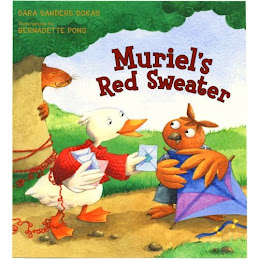
ROSIE'S WALK by Pat Hutchins is a classic and one of my favorites. (In fact, ROSIE'S WALK, in part, inspired me to write my picture book MURIEL'S RED SWEATER.)

In ROSIE'S WALK there is a story about a chicken who goes for a walk around the farm and gets back home in time for dinner. Now, if you just read the printed page, that's all you would know. But, Hutchins' illustrations add a whole other layer to the tale. We see a fox trying to catch the chicken. At every turn, the fox is thwarted (in a humorous manner) and Rosie makes it back home. Here, the book entirely depends on the marriage of story and illustration.

ROSIE'S WALK is an "extreme" example, if you will. But, the concept is the same. Whenever the pictures add to the story, instead of just capturing a moment in the text, then you have a true picture book.

Editors know this. Librarians know this. If you are both author and illustrator, pairing the two most likely comes naturally. The challenge for an author of picture books is to leave enough room for the illustrator to do his or her thing and add to the story.

And when this happens, you can feel the affect, even if you couldn't name it before. You are reading a true picture book.