Hello Readers!
As you can see, I'm no longer updating this Children's Writer Gal blog.
I'm now blogging at: http://planetparenting.blogspot.com
Please stop by and check it out!
Thanks,
Dara Dokas
Wednesday, October 3, 2012

Monday, August 23, 2010
Children's Writer Gal Takes a Hiatus

The Children's Writer Gal Blog will be taking a hiatus, a sort of long-lasting cat nap. I will instead be focusing my blogging efforts on my other blog - Bookshop Gal.
Please feel free to stop by Bookshop Gal at:
http://bookshopgal.blogspot.com
Thanks to everyone who read Children's Writer Gal.
Dara Dokas
Monday, March 29, 2010
Teaching at the Loft

On Saturday, April 10, I will be teaching my first class for the Loft Literary Center at Open Book in downtown Minneapolis. I'm really looking forward to it. It's a one-day workshop called The Nuts and Bolts of Writing for Children. The class is geared for beginning children's writers and anyone interested in learning about writing for children.
This workshop is not a craft class. In other words, we will not be discussing plot, setting and characters. We will be discussing basically everything else. We will tackle the big, important questions (and the little ones too) about the business of writing for kids. This will include everything from the different categories of children's books to finding a publisher to writing a cover letter.
If you, or anyone you know, might be interested in learning more about the nuts and bolts of writing for children, there's still time to sign up.
You can call the Loft at 612-379-8999 or register online.
Here is a link to the class description: http://www.loft.org/classes/adult-classes/childrens-and-young-adult-literature page=shop.product_details&flypage=flypageLoft.tpl&product_id=57&category_id=10
The workshop should be a lot of fun. And I'll have some cool giveaways!
Friday, March 5, 2010
Spotlight on Books

This coming April, I will be a featured author at the 22nd Annual Spotlight on Books conference. This conference is for anyone interested in Youth Literature. It's being held April 23 and 24, 2010 at Ruttger's Sugar Lake Lodge Resort near Grand Rapids, Minnesota.
Not only will the setting be beautiful, but the presenters will be very interesting. The Friday afternoon workshop focuses on challenges that today's librarians face. Saturday is Author Day with three featured Children's Authors:
• Ben Mikaelsen, GHOST OF SPIRIT BEAR
• Henry Cole, A NEST FOR CELESTE
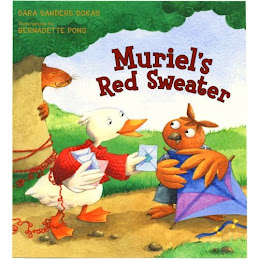
• Dara Dokas, MURIEL'S RED SWEATER
• plus, a round table with Regional Authors.
If you are interested in finding out more about the conference, go to http://nlln.org/spotlight.html OR call 1-800-450-1032.
It would be fun to see you there!
To learn more about Henry Cole's new book, A NEST FOR CELESTE, visit my Bookshop Gal Blog at: http://bookshopgal.blogspot.com/.
Friday, February 26, 2010
A visit to Alcatraz

Welcome back everyone! I apparently took January and most of February off from blogging, but I'm back.
In January, I had the great opportunity to visit San Francisco and Alcatraz island, infamous prison home to many well-known criminals including Machine Gun Kelly and Al Capone.
Before leaving for our trip, I asked my daughter (age 11) what she wanted to do most. She answered, "Visit Alcatraz." So we did. And it was so worth it! We took the Self-Guided Audio Tour, which was fascinating. The tour is completely narrated by former prison guards and inmates! The audio tour directs you around the prison with stories of daily life, infamous inmates, and escape attempts. You really get a sense of what it was like.
Upon arriving home, the first thing my daughter did was read AL CAPONE DOES MY SHIRTS by Gennifer Choldenko. The she quickly followed it up with the sequel AL CAPONE SHINES MY SHOES by Gennifer Choldenko. Now, AL CAPONE DOES MY SHIRTS is on my bedside table with a directive from my daughter to read it ASAP! So now I am.
Choldenko, who lives in the Bay Area, was a volunteer on Alcatraz. She really did her research before writing her two books. Both Al CAPONE books incorporate history of the people and the place. AL CAPONE DOES MY SHIRTS is set in 1935 and told by fictional character "Moose" Flanagan who is one of the children living on the island. Yes, there were children on Alcatraz! Many prison workers lived with their families on the island. What a way to grow up!
I have always loved historical fiction. And Choldenko has done a superb job of keeping the story funny and fresh while infusing it with history. And the Newbery folks agreed because AL CAPONE DOES MY SHIRTS received a Newbery Honor Award.
So, now I've got to get reading. My daughter keeps asking me how far I am. Don't you love that kind of enthusiasm? I had better live up to it and finish reading quickly. Then we can really talk about it.
Sunday, December 13, 2009
A Kick-in-the-Pants!

If you're a writer, you already know this. But I want to say it again. A Writer's Group (Critique Group) is very, very important! A good group will offer excellent feedback on your writing, will share industry information, and provide a consistent outlet for your work.
This last one is what I needed most recently. What I needed was a Kick-in-the-Pants! Winter hit me hard this year, plus I got very busy. So busy, in fact, that I hadn't written any new material in weeks! (I apologize to my blog followers for being so LAME lately. This will change as of now.)
I didn't bring anything to our November Pita meeting. I didn't want to show up to our December meeting empty handed either. I saw the date getting closer and felt the pressure to produce. This is self-imposed pressure, but very motivating. I didn't want two whole months to slip away without some useful feedback from my fellow writers!
I bet the reason the Nanowrimo (National Novel Writing Month) takes place in November is because November sucks! (You can see my obvious bias here. I live in a state where November comes early and hard and makes me want to hibernate like the bears.) But, seriously, a significant outside motivator like Nanowrimo gets people writing more when they might be writing less.
So, I dug out the chapter book I was working on and re-looked at the Hermit Crab chapter. Thank God for Hermit Crabs and the Flaming Pitas! I feel like I'm back on track.
Monday, November 2, 2009
Writing Retreat

Recently, I had the wonderful opportunity to go on a three-day writing retreat with 3 of the 4 women in my writer's group. This was actually the first time I had ever gone on an official writing retreat, and it was well worth it!
We stayed at "The Sequel", a beautiful, cozy cabin on a lake. It was cold and rainy, then snowy. But, frankly, that was fine with me. I was less inclined to go exploring outside and more inclined to happily write away the afternoon.
Before the retreat we planned out a schedule for each day. Our day looked something like this:
8:00 am - Breakfast
9:00 am - Writing Exercise, then Free Writing Time
Noon - Lunch
1:00 pm - Hike and Write
3:00 pm - Free Writing Time
6:00 pm - Dinner
7:00 pm - Free Writing Time
8:00 pm - Games
We each came prepared to lead one writing exercise. These included exercises on character, setting, plot, and story starters. Writing exercises were kept fairly short so that we could optimize free writing time.
The other, extremely wonderful thing we did that helped optimize our writing time, was that we hired a great chef (and friend) to cook for us on the retreat. We were all so happy to have her with us!
All in all, I got a lot of writing done and had a great time. In fact, all of us had such a good time that we plan to go on a writing retreat twice a year.
If you (alone or with your writing group) can put together some kind of organized writing retreat, I highly recommend it. What a great way to get some concentrated writing accomplished and have fun along the way!
Subscribe to:
Posts (Atom)